 Skip to main content


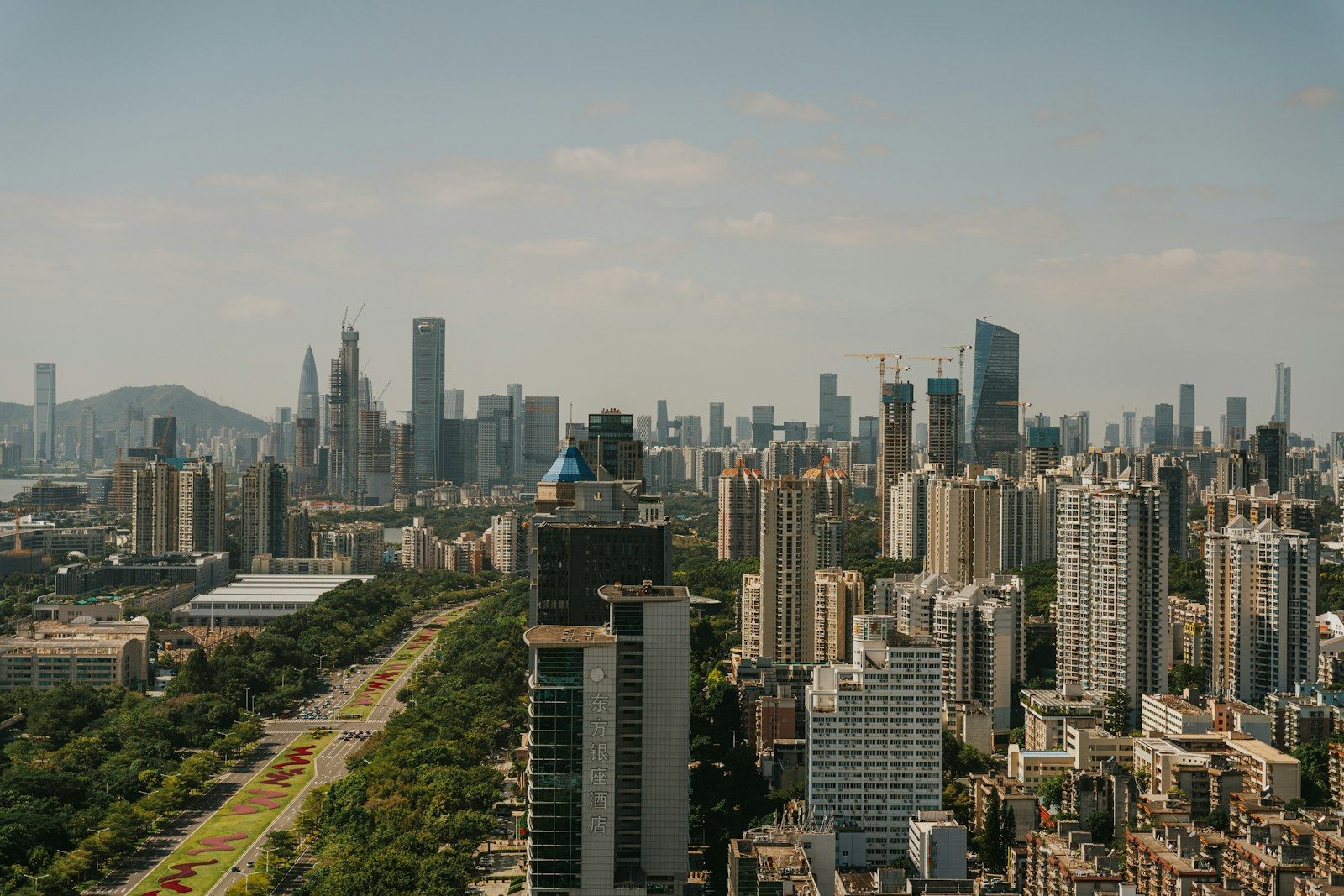
On 30 January 2026 the Shenzhen Statistics Bureau reported that the city's 2025 GDP reached 3.873 trillion yuan, up 5.5% in real terms and 0.5 percentage points above the national rate. Finance and information services led growth, while exports fell 2.6%, the first annual decline since 2010.
Overview
The Shenzhen Statistics Bureau released the city's 2025 economic data on 30 January 2026. According to Yicai, Shenzhen's gross domestic product (GDP) for 2025 was 3,873.18 billion yuan, up 5.5% year on year at constant prices and 0.5 percentage points above the national growth rate. The nominal increase was about 193 billion yuan. Cumulative growth was 5.2% in the first quarter, 5.1% in the first half and 5.5% in the first three quarters, ending the year at 5.5%.
Background
Among mainland China's major cities, Shenzhen has an economy driven by two engines: manufacturing centred on electronics and communications equipment, and services such as finance and information technology. On 22 January, Shenzhen Customs and the city's commerce department reported that Shenzhen's total foreign trade reached 4.55 trillion yuan in 2025, the highest of any mainland city. Nanshan District has also announced that its GDP exceeded 1 trillion yuan in 2025, drawing renewed attention to the concentration of advanced industries in the city.
Key Points
| Indicator | 2025 result |
|---|---|
| GDP | 3,873.18 billion yuan (up 5.5%) |
| Secondary industry value added | 1,448.25 billion yuan (up 4.1%) |
| Tertiary industry value added | 2,422.12 billion yuan (up 6.3%) |
| Industrial value added (above designated size) | up 5.4% |
| Retail sales of consumer goods | 1,025.99 billion yuan (up 2.3%) |
| Total foreign trade | 4,553.39 billion yuan (up 1.4%) |
| Exports / imports | 2,738.78 billion yuan (down 2.6%) / 1,814.61 billion yuan (up 8.0%) |
| Fixed-asset investment | down 21.7% |
- Services led growth: Finance grew 12.1% and information transmission, software and IT services grew 10.3%.
- Fast-growing new products: Output of 3D printing equipment rose 45.1%, industrial robots 43.1% and civilian drones 40.1%.
- Trade: Exports recorded their first annual decline since 2010, while high-tech product exports rose 10.1%.
- Investment: Real estate development investment fell 31.0%, while investment in information and software services rose 67.7% and industrial technology upgrading investment rose 19.2%.
- Manufacturing by sector: General equipment manufacturing grew 13.9%, computer, communication and other electronic equipment 6.2%, and special equipment 5.1%. Industrial value added rose 6.4% in December alone.
- Consumption mix: Among larger retailers, sales of cultural and office supplies rose 19.5%, gold and jewellery 14.9%, home appliances and audio-visual equipment 12.3%, and communication equipment 8.9%.
- Finance and logistics: Deposits at financial institutions rose 7.8% and loans 5.1%. Airport passenger traffic rose 8.1% and port container throughput rose 6.0%.
Implications for Japan-Shenzhen Exchange
According to the Shenzhen Municipal Commerce Bureau, 1,171 Japanese companies had invested in Shenzhen as of August 2025. Structural changes in the city's economy, including the upgrading of manufacturing and the expansion of finance and information services, are likely to be an important reference for Japanese companies operating there as they plan their business direction. In particular, the rapid growth in output of industrial robots, drones and 3D printing equipment may widen the points of contact with Japanese companies strong in components, materials and equipment, and this is attracting attention.
On the other hand, the decline in exports, the drop in fixed-asset investment and sluggish consumption growth are seen as reflecting external uncertainty and the adjustment in the property market. The 8.0% rise in imports indicates continued demand for overseas products and parts, which is likely to interest Japanese companies involved in exports to China.
Outlook
Yicai noted that as Shenzhen's economy approaches 4 trillion yuan, retail sales growth has lagged GDP growth for three consecutive years and infrastructure investment remains weak. The city's growth target and key policies for 2026 are expected to be set out in the government work report at the session of the Shenzhen Municipal People's Congress in February.
From the Association
The Association will continue to monitor Shenzhen's economic statistics and structural changes and to share relevant information with its members. We will keep providing a platform for Japanese and Shenzhen companies to deepen exchange by drawing on their respective strengths.
Sources
- 第一财经:迈向4万亿,深圳经济靠什么换档提速|湾区观察
- Shenzhen Government Online (Xinhua): South China's Shenzhen tops Chinese cities in foreign trade for 2025
- Shenzhen Government Online: Shenzhen's Nanshan joins China's district-level trillion-yuan GDP club
- Shenzhen Municipal Commerce Bureau: Shenzhen-Japanese-Invested Enterprises Industry Policy Exchange Meeting
This article is based on publicly available information and is provided for reference only; accuracy and completeness are not guaranteed.