 Skip to main content


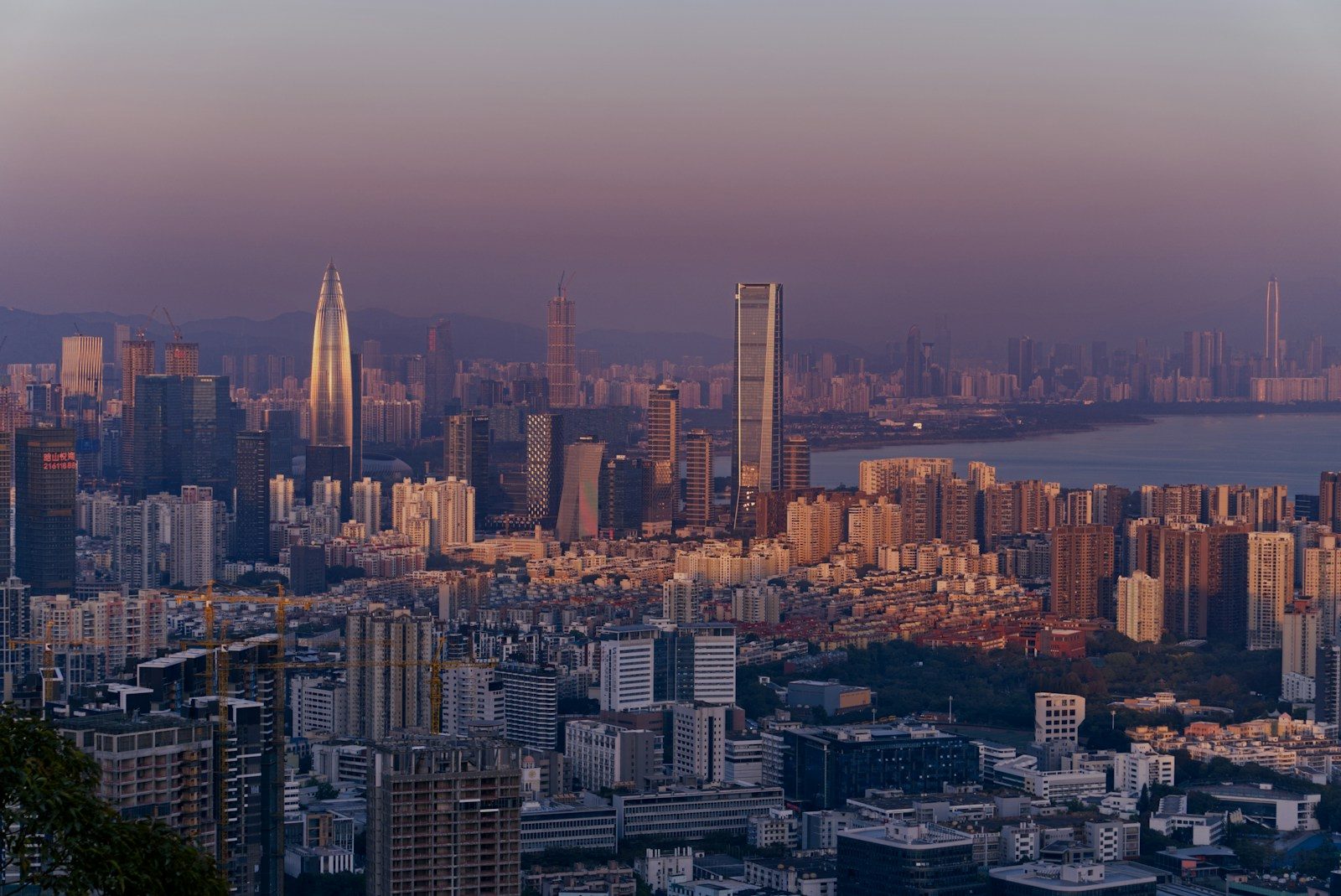
The Shenzhen Statistics Bureau said on 24 July that the city's GDP rose 5.8% year on year to RMB 1,984.348 billion in the first half of 2026. Manufacturing value added grew 9.3% and goods trade surged 33.0%, while consumption and investment remained weak.
Overview
On 24 July 2026, the Shenzhen Statistics Bureau, citing Guangdong Province's unified GDP accounting, announced that Shenzhen's gross domestic product in the first half of 2026 reached RMB 1,984.348 billion, up 5.8% year on year at constant prices, matching the growth rate of the first quarter. According to the 21st Century Business Herald, this pace is above the city's full-year growth target of 5.0%. Shenzhen Special Zone Daily and other media reported the details on 25 July.
By sector, primary industry value added was RMB 1.228 billion (up 4.0%), secondary industry RMB 714.465 billion (up 6.4%) and tertiary industry RMB 1,268.655 billion (up 5.5%).
Background
Shenzhen is one of China's leading economic centres, driven both by manufacturing (electronics, telecommunications equipment, new energy vehicles and batteries) and by services such as finance and information technology. In recent years the city has stepped up investment in frontier areas such as artificial intelligence and robotics, while a property market correction and sluggish household consumption have remained challenges. Shenzhen has been described as China's "number one industrial city" for four consecutive years, and manufacturing remains its backbone. The latest figures again show a pattern of strong manufacturing and external demand alongside weak domestic demand. Even excluding real estate development, fixed-asset investment fell 7.7%.
The release covered production, services, consumption, investment, trade, finance and prices, giving a broad picture of the city's economy at mid-year. Deposits in domestic and foreign currencies stood at RMB 15,530.998 billion at the end of June, up 9.7%, while loans reached RMB 10,301.732 billion, up 4.6%.
Key Points
| Indicator | H1 2026 |
|---|---|
| Industrial value added (above designated size) | +8.7% (manufacturing +9.3%) |
| Computers, communications and electronics | +12.3% |
| Total goods trade | RMB 2,879.095 billion, +33.0% |
| Exports / imports | RMB 1,507.354 billion (+15.5%) / RMB 1,371.741 billion (+59.8%) |
| Retail sales of consumer goods | RMB 500.581 billion, +1.2% |
| Fixed-asset investment | -14.6% (real estate development -28.6%) |
| Consumer prices | +0.8% |
- High-tech products: output of 3D printing equipment rose 58.1%, industrial robots 43.9% and lithium-ion batteries 25.5%. General equipment manufacturing grew 13.2% and special equipment manufacturing 12.8%.
- Services: financial sector value added grew 10.6%, and information transmission, software and IT services 7.8%. Port container throughput rose 7.7% and airport passenger traffic 3.2%.
- Trade: high-tech exports rose 26.4%. In June alone, total trade grew 42.1%, an acceleration.
- Investment mix: although overall investment fell, high-tech industry investment rose 27.4%, industrial technology upgrading 24.2% and infrastructure 10.1%, showing sharp divergence between sectors.
- Consumption: retail sales of telecommunications equipment rose 42.4% and furniture 19.1%, while cosmetics and cultural and office supplies each grew 11.2%. Catering revenue rose 5.1% and online retail by larger firms 8.8%, but overall growth was only 1.2%.
Implications for Japan-Shenzhen Exchange
The nearly 60% jump in imports and the rapid expansion in output of industrial robots, batteries and equipment are likely to be of interest to overseas suppliers of components, materials and manufacturing equipment. As Japanese companies have strengths in these fields, trends in Shenzhen's manufacturing sector are expected to remain an important reference for planning trade and local operations.
On the other hand, retail sales grew by only 1.2%, indicating that consumption lacks momentum. Japanese companies running retail, restaurant and other consumer-facing businesses in Shenzhen may need to track shifts in demand by product category closely. Attention is also turning to how far the expansion in high-tech investment will feed through to consumption and employment.
Outlook
The release did not include a forecast for the second half or new stimulus measures. How long the decline in property investment and weak consumption persist, and whether external demand holds up, will likely shape full-year growth.
From the Association
The Association will continue to follow Shenzhen's economic data and policy developments and to share useful information with members. We will keep providing opportunities for exchange to support economic ties between Japan and Shenzhen.
Sources
This article is based on publicly available information and is provided for reference only; accuracy and completeness are not guaranteed.