 Skip to main content


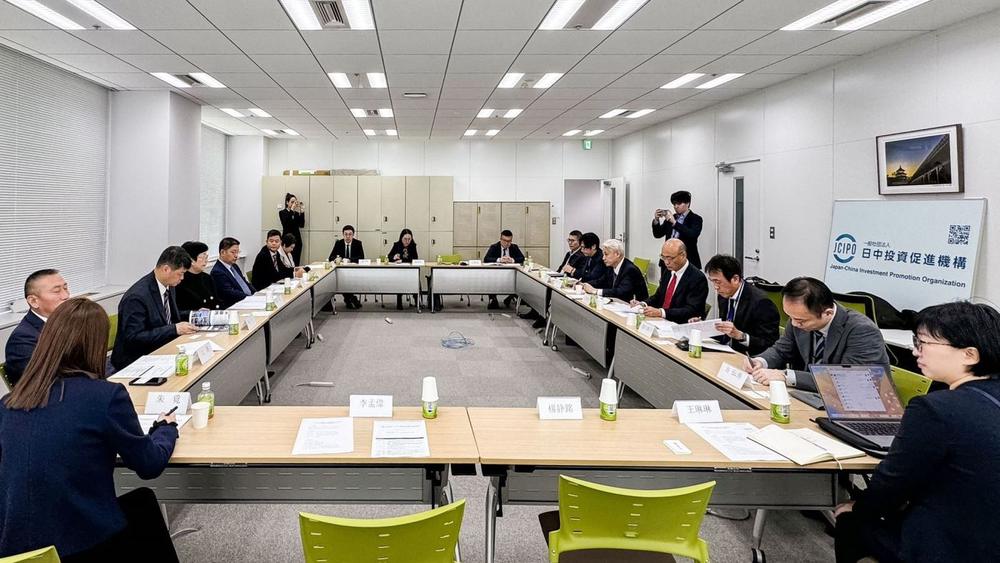
Tokyo, November 29. The bustle of Roppongi, like the economic heartbeat of the city, pulsed with unceasing energy. In this district that embodies the essence of business, a delegation of the Shenzhen Municipal People's Congress led by Pei Lei, Vice Chair of the Standing Committee of the Shenzhen Municipal People's Congress, brought with it Shenzhen's innovative development and its wish for cooperation, and held a discussion meeting with the Japan-China Investment Promotion Organization and the Japan Shenzhen Economic, Trade and Cultural Promotion Association.

At the meeting, Vice Chair Pei Lei, in a gentle yet firm tone, painted a magnificent picture of Shenzhen's innovation and development. In the first three quarters of this year, 6,421 new foreign-invested enterprises were established in Shenzhen, accounting for 15.2% of all new foreign-invested enterprises in China. More than 310 Fortune Global 500 companies have a presence in Shenzhen, providing a constant source of momentum for the city's economic and social development. From this, participants sensed what is "new" about Shenzhen: new development.

Vice Chair Pei Lei also noted that although Shenzhen, a city of 17 million people, has an average age of 32.5, it is expected to become an aged society by 2030. For this reason, Shenzhen intends to plan ahead, actively explore sound policies for an aging society, and pursue active exchanges and cooperation with Japan in addressing population aging, promoting the silver economy and achieving healthy elderly care. Through these remarks, participants identified new "points" of contact for further exchanges and cooperation with Shenzhen.
Vice Chair Pei Lei stressed that Shenzhen is actively promoting the development of new quality productive forces, making innovation the leading strategy for urban development, strengthening intellectual property protection, and building an innovation ecosystem that covers the entire process. Since 2022, the Shenzhen Municipal People's Congress has enacted regulations including the "Regulations of the Shenzhen Special Economic Zone on Promoting the Artificial Intelligence Industry," the "Regulations of the Shenzhen Special Economic Zone on Promoting the Digital Economy Industry" and the "Regulations of the Shenzhen Special Economic Zone on the Administration of Intelligent Connected Vehicles," safeguarding the development of new quality productive forces and emerging industries. From this, participants sensed the "order" and "quality" that Shenzhen pursues as its development deepens.
Vice Chair Pei Lei expressed appreciation for the past efforts of the Japan-China Investment Promotion Organization and the Japan Shenzhen Economic, Trade and Cultural Promotion Association, commending the Association, under the leadership of Honorary President Jiang Feng and President Weng Daokui, for holding forums, organizing delegations to Shenzhen, and helping incubate and launch multiple cooperation projects, thereby actively promoting exchanges and cooperation between Japan and Shenzhen.

At the meeting, Toyoki Oka, Director General of the Japan-China Investment Promotion Organization, fondly recalled that when he was stationed in China as a representative of Mizuho Bank, he visited Shenzhen every month on study tours, making him one of the "witnesses" to Shenzhen's development. To this day, Director General Oka frequently encourages Japanese companies to go to Shenzhen in person to "walk around" and "take a look," and to understand why more than 32,000 Japanese companies still invest and do business in China and in Shenzhen. He also mentioned that in one city in Oita Prefecture, the elderly already account for 79% of the population, and said that Japan and China should cooperate more in the elderly care and wellness industry.
Jiang Feng, Editor-in-Chief of the Japan monthly edition of the People's Daily Overseas Edition and Honorary President of the Association, said at the meeting that the presentation by the Shenzhen People's Congress delegation once again gave him a sense of how "substantive" Shenzhen is. He highlighted in particular the "six 90 percents" mentioned by Vice Chair Pei Lei: more than 90% of innovative enterprises are local companies, more than 90% of R&D institutions are set up within enterprises, more than 90% of R&D personnel work in enterprises, more than 90% of R&D funding comes from enterprises, more than 90% of service invention patents come from enterprises, and more than 90% of invention patents from major science and technology projects come from leading enterprises. All of these, he said, are issues of real concern to Japan's business community. He also suggested that in the future, while talking about its development through technological innovation, Shenzhen should actively present the development of its market as well, so that foreign companies can appreciate the "market effect" of China and Shenzhen.
The meeting concluded in a warm atmosphere. Participants exchanged souvenirs, a gesture that was not merely a transfer of objects but an exchange of hearts. The Shenzhen People's Congress delegation and the Japanese participants captured the moment on camera, planting the seeds of cooperation deep in their hearts.
Members of the visiting delegation, including Wang Hushan, Director of the Social Development Work Committee of the Standing Committee of the Shenzhen Municipal People's Congress, and Yang Jie, Deputy Director of the Shenzhen Emergency Management Bureau, attended the meeting. Guests in attendance also included Atsushi Takigawa and Fang Chuanxiu of the Japan-China Investment Promotion Organization, Tian Changhao, Chief Representative of the Shenzhen Economic and Trade Representative Office in Japan, and Weng Daokui, President, and Wu Xiaole, Executive Vice President, of the Japan Shenzhen Economic, Trade and Cultural Promotion Association.